
Hello! Grant Zizzo here. I work as Principal Engineer alongside my wife, artist Aneesa.
The Scheherazade Project asks three questions:
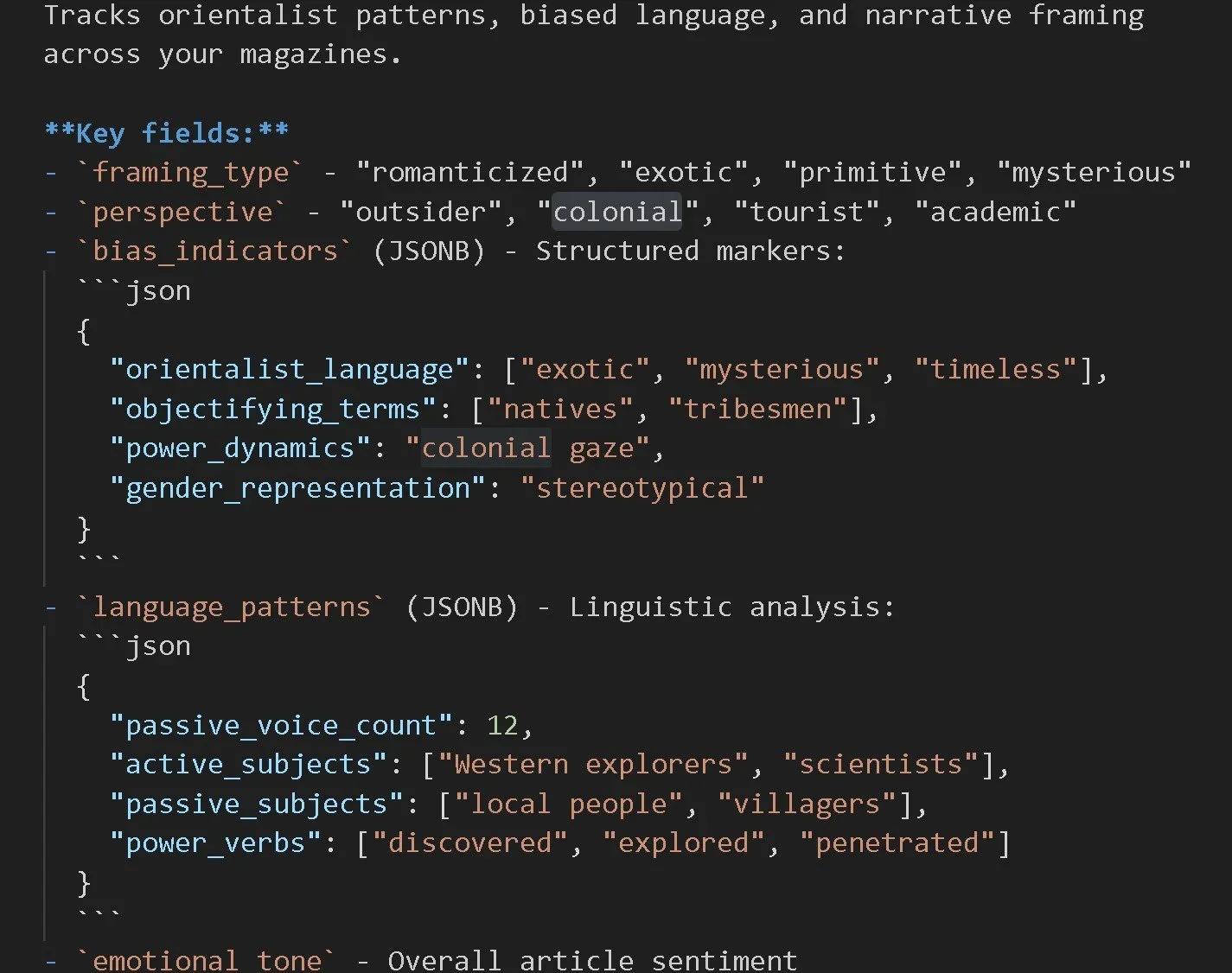
Can machines reliably identify and catalogue narrative bias in visual media? Specifically, can computer vision and AI detect patterns of orientalism across a century of National Geographic coverage?
Can objective data capture subjective creative process? When a trained artist creates abstract expressionist collage, work that succeeds when an audience finds it "sublime,” can we catalogue the subconscious decisions from environmental and compositional data, then train a vision-language model to reproduce that process?
Can we extract relational meaning from creative choices? From the data collected in both pursuits, can we find correlations between the actual collaged content and the artist's subconscious process—proving (or disproving) that creative intuition follows measurable patterns?
Project Goals
Artistic Output:
Create 12 large-scale (8'×4') abstract expressionist collages, each constructed entirely from a single National Geographic magazine issue
Technical Infrastructure:
Operate entirely on local-only hardware architecture using exclusively open-source software and models
Document complete power usage of the system throughout the project
Bias Analysis Pipeline:
Apply peer-reviewed methodologies of narrative bias classification through a vision-language model (VLM) pipeline to analyze National Geographic source material
Record analysis at magazine, article, page, and image levels
Document complete VLM thought-chain for each analysis, establishing provenance for all interpretations
Artistic Process Documentation:
Create comprehensive database tracking all elements of creative creation through:
High-resolution photographic capture of every collage piece (tesserae) placement
Environmental monitoring: temperature, humidity, time of day, outdoor weather conditions
16-point EEG monitoring during active creation
Heart rate monitoring
LiDAR tracking of artist's body and hand movements, velocity, and acceleration
Direct Inferencing (Objective Measurement):
Time intervals between tesserae placement
Computer vision-aided analysis: color, size, and x-y coordinates of each tesserae
Clinically established brain wave interpretations from EEG data (focus states, flow states)
Experimental Inferencing (Tagged for Methodological Provenance):
Exploratory EEG interpretations including:
Saccade detection
Subvocalization detection
"Second-guessing" patterns
Correlative Analysis:
Deploy LLM to identify correlations between data points across multiple levels of experimental accuracy, seeking patterns that link objective creative decisions to measurable physiological and environmental conditions
Generative Output (Testing Machine Learning of Artistic Process):
Train a model on the complete dataset of artistic decisions, physiological data, and environmental conditions
Test the trained model's ability to generate collage compositions through two experiments:
Novel Generation: Feed the model a previously unused National Geographic issue and generate a unique collage composition, testing whether it has learned generalizable creative principles
Reproduction Attempt: Feed the model the same magazine issue previously used by the artist and attempt to reproduce compositional decisions, testing whether the machine can replicate the artist's subconscious process when given identical source material
Code will be available via GitHub soon!